Loading...
Searching...
No Matches
TdjWebComponent Class Reference
A base class which can be subclassed to create a HTTP component for a Web site. More...
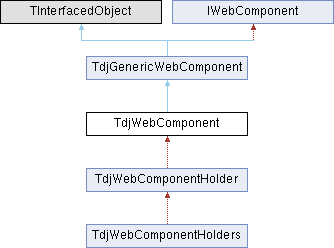
Inheritance diagram for TdjWebComponent:
Public Member Functions | |
| TdjWebComponent () | |
| ~TdjWebComponent () | |
| TIdHTTPSession | GetSession (TdjServerContext Context, TdjRequest Request, TdjResponse Response, const Boolean Create=True) |
| Get or create a HTTP session. | |
| IWebComponentConfig | GetWebComponentConfig () |
| Returns a IWebComponentConfig object, which contains initialization parameters for this component. | |
| Init () | |
| A convenience method which can be overridden so that there is no need to call inherited Init(config). | |
| Init (const IWebComponentConfig Config) | |
| Called by the container on startup. | |
| Service (TdjServerContext Context, TdjRequest Request, TdjResponse Response) | |
| Handle a HTTP request. | |
Public Attributes | |
| IWebComponentConfig | Config |
Protected Member Functions | |
| OnDelete (TdjRequest Request, TdjResponse Response) | |
| Called by the server to handle a DELETE request. | |
| OnGet (TdjRequest Request, TdjResponse Response) | |
| Called by the server (via the service method) to allow a component to handle a GET request. | |
| string | OnGetETag (TdjRequest Request) |
| Returns the entity tag (ETag) of the resource a GET/HEAD request would return. | |
| TDateTime | OnGetLastModified (TdjRequest Request) |
| Returns the time the WebComponent object was last modified. | |
| OnHead (TdjRequest Request, TdjResponse Response) | |
| Called by the server (via the service method) to allow a component to handle a HEAD request. | |
| OnOptions (TdjRequest Request, TdjResponse Response) | |
| Called by the server (via the service method) to allow a component to handle a OPTIONS request. | |
| OnPatch (TdjRequest Request, TdjResponse Response) | |
| Called by the server to handle a PATCH request. | |
| OnPost (TdjRequest Request, TdjResponse Response) | |
| Called by the server to handle a POST request. | |
| OnPut (TdjRequest Request, TdjResponse Response) | |
| Called by the server to handle a PUT request. | |
| OnTrace (TdjRequest Request, TdjResponse Response) | |
| Called by the server to handle a TRACE request. | |
Detailed Description
A base class which can be subclassed to create a HTTP component for a Web site.
A subclass of TdjWebComponent must override at least one method, usually one of these:
- OnGet, if the web component supports HTTP GET requests
- OnPost, for HTTP POST requests
- OnPut, for HTTP PUT requests
- OnDelete, for HTTP DELETE requests
- Note
- Method handling notes and current limitations:
- every On* handler that is not overridden responds with 405 Method Not Allowed, with one exception: HEAD is derived from OnGet (see OnHead).
- a 405 response, whether from a not-overridden handler or set explicitly, always carries an Allow header listing the methods this component supports.
- OPTIONS is answered by the framework itself unless OnOptions is overridden: the default response is 200 with an Allow header and no body (see OnOptions).
- an unrecognised HTTP method responds with 501 Not Implemented.
- conditional GET/HEAD is supported through OnGetLastModified (If-Modified-Since) and OnGetETag (If-None-Match). If a request carries If-None-Match, it alone decides the outcome, per RFC 7232 Section 3.3; If-Modified-Since is only consulted when the request has no If-None-Match. A 304 response carries Date, and Last-Modified / ETag whenever the component supplies them.
- Threading: the framework creates exactly one instance of each registered component, and every concurrent request runs through that same instance's Service method on its own thread. Do not keep per-request state in instance fields — two requests handled at the same time will read and write the same field, corrupting each other's data. Use local variables for anything request-specific, and if state truly must be shared across requests, synchronize access to it explicitly (e.g. with a critical section).
Constructor & Destructor Documentation
◆ TdjWebComponent()
| TdjWebComponent::TdjWebComponent | ( | ) |
◆ ~TdjWebComponent()
| TdjWebComponent::~TdjWebComponent | ( | ) |
Member Function Documentation
◆ GetSession()
|
inherited |
Get or create a HTTP session.
- Note
- it requires the current TdjServerContext, so it cannot be called from one of the HTTP method handlers (OnGet etc.). It can be called from the Service method.
- if the context was created with the Auto Session option, this method will always return a session independent of the Create parameter
- Parameters
-
Context HTTP server context Request HTTP request Response HTTP response Create if True, create a session if no one exists
- Returns
- HTTP session
◆ GetWebComponentConfig()
|
inherited |
Returns a IWebComponentConfig object, which contains initialization parameters for this component.
- Exceptions
-
EDarajaLifecycleException if the method is called before the component has been initialized.
Implements IWebComponent.
◆ Init() [1/2]
|
inherited |
A convenience method which can be overridden so that there is no need to call inherited Init(config).
References TdjGenericWebComponent().
◆ Init() [2/2]
|
inherited |
Called by the container on startup.
- Note
- if this method is overridden, the overriding code must also call inherited Init.
- Parameters
-
Config the configuration
- Exceptions
-
EDarajaException if initialization failed
Implements IWebComponent.
References Init().
Referenced by Init().
◆ OnDelete()
|
protected |
Called by the server to handle a DELETE request.
- Parameters
-
Request The HTTP request to process Response The HTTP response to fill
- Exceptions
-
EDarajaException if an exception occurs
References OnGet().
◆ OnGet()
|
protected |
Called by the server (via the service method) to allow a component to handle a GET request.
Referenced by OnDelete().
◆ OnGetETag()
|
protected |
Returns the entity tag (ETag) of the resource a GET/HEAD request would return.
If unknown, this method returns '' (the default), which means no ETag is offered and no If-None-Match comparison is done.
WebComponents that support HTTP GET requests and can cheaply compute a stable identifier for their current representation should override this method. The returned value is sent as the ETag header, quoted per RFC 7232 if not already (e.g. '"abc123"'), and compared against a request's If-None-Match header using a weak comparison (a leading 'W/' is ignored on both sides).
- Parameters
-
Request HTTP request
- Returns
- the entity tag, or '' if unknown
◆ OnGetLastModified()
|
protected |
Returns the time the WebComponent object was last modified.
If the time is unknown, this method returns 0 (the default).
WebComponents that support HTTP GET requests and can quickly determine their last modification time should override this method. This makes browser and proxy caches work more effectively, reducing the load on server and network resources.
- Parameters
-
Request HTTP request
- Returns
- the last modified timestamp
◆ OnHead()
|
protected |
Called by the server (via the service method) to allow a component to handle a HEAD request.
The default implementation runs the same code path as a GET request, including the OnGetLastModified / OnGetETag conditional handling, and the response body is suppressed. A component which overrides OnGet therefore answers HEAD requests with the GET headers and no content. If OnGet is not overridden either, the response is 405 Method Not Allowed.
- Note
- because the GET path runs in full, an expensive OnGet does its work for a HEAD request too, and any side effect of OnGet is triggered by a HEAD request as well. Override this method to handle HEAD separately.
- Parameters
-
Request The HTTP request to process Response The HTTP response to fill
- Exceptions
-
EDarajaException if an exception occurs
◆ OnOptions()
|
protected |
Called by the server (via the service method) to allow a component to handle a OPTIONS request.
The default implementation responds with 200 and an Allow header listing the HTTP methods this component supports (i.e. the On* handlers that are overridden), with no response body.
- Parameters
-
Request The HTTP request to process Response The HTTP response to fill
- Exceptions
-
EDarajaException if an exception occurs
◆ OnPatch()
|
protected |
Called by the server to handle a PATCH request.
- Parameters
-
Request The HTTP request to process Response The HTTP response to fill
- Exceptions
-
EDarajaException if an exception occurs
◆ OnPost()
|
protected |
Called by the server to handle a POST request.
- Parameters
-
Request The HTTP request to process Response The HTTP response to fill
- Exceptions
-
EDarajaException if an exception occurs
◆ OnPut()
|
protected |
Called by the server to handle a PUT request.
- Parameters
-
Request The HTTP request to process Response The HTTP response to fill
- Exceptions
-
EDarajaException if an exception occurs
◆ OnTrace()
|
protected |
Called by the server to handle a TRACE request.
- Parameters
-
Request The HTTP request to process Response The HTTP response to fill
- Exceptions
-
EDarajaException if an exception occurs
◆ Service()
| TdjWebComponent::Service | ( | TdjServerContext | Context, |
| TdjRequest | Request, | ||
| TdjResponse | Response ) |
Handle a HTTP request.
The status code of the response always should be set for a component that throws or sends an error.
- Note
- a custom Web Component should not override this method.
- Parameters
-
Context HTTP server context Request HTTP request Response HTTP response
- Exceptions
-
EDarajaException if an exception occurs that interferes with the component's normal operation
Implements IWebComponent.
Member Data Documentation
◆ Config
|
inherited |